
Why Trust Begins Before You Have All the Answers
Trust is not certainty that everything will work out. It is the willingness to move forward carefully even when some answers have not arrived.
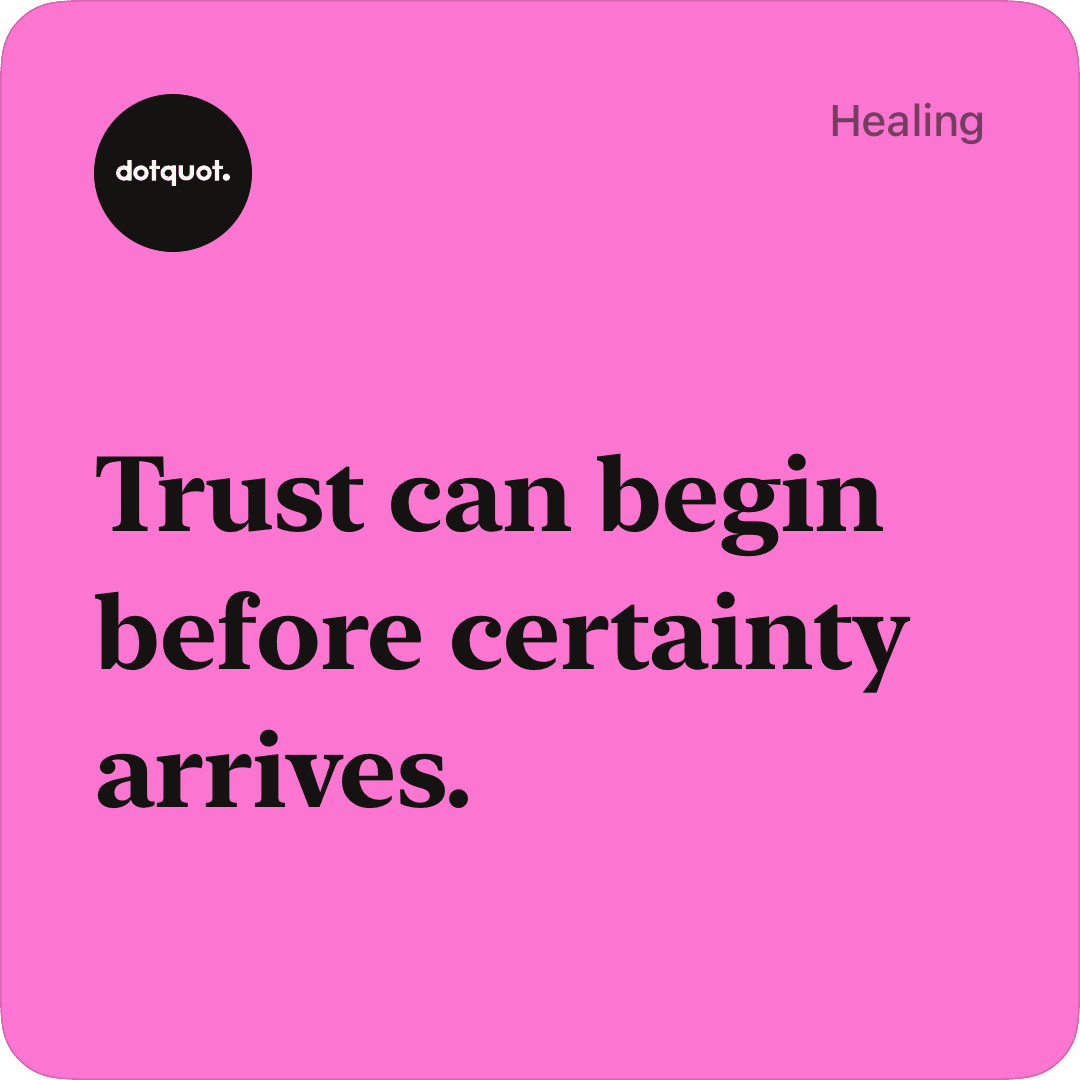
We like to know how things will turn out before we make important decisions. We want to be sure that the people we depend on won't disappoint us, that our plans will work, and that the choices we make won't lead to regret. But life doesn't provide that kind of certainty. There's always something we don't know.
Trust includes uncertainty
Trust requires a willingness to live with some uncertainty. Whether we're trusting another person, making a difficult decision, or simply believing that things might get better, we're accepting the possibility that our expectations won't be met. That's not necessarily a bad thing. We can't wait until every question has been answered before we begin living.
Relationships cannot be guaranteed
Think about the relationships in your life. You can't know for certain that someone will always be honest with you or that they'll never disappoint you. Even people who love you will sometimes make mistakes. But if you refuse to trust anyone until they've proven themselves beyond all doubt, you'll probably spend a lot of your life keeping people at a distance.
Trust still requires judgment
Of course, trusting someone doesn't mean ignoring warning signs. Some people aren't trustworthy, and some situations require caution. There's a difference between having faith and being careless. Good judgment involves paying attention, learning from experience, and being willing to change your mind when new information becomes available.
You also have to trust yourself
The same principle applies to trusting yourself. You won't always know whether you're making the right decision. Sometimes you'll have to act with limited information and make adjustments along the way. You might get things wrong. But refusing to make a decision because you can't guarantee the outcome is itself a decision, and it can have consequences.
Certainty cannot remove every fear
One of the problems with seeking certainty is that we tend to imagine that knowing more will eliminate our fears. Sometimes it does. But there will always be something else to worry about. We can spend years trying to create a future in which nothing can go wrong, only to discover that such a future doesn't exist.
Hope does not require certainty
Trust isn't the belief that everything will happen the way you want it to. It's the willingness to move forward even though you don't know exactly what will happen. You can be hopeful without being certain. You can be careful without being fearful.
Some answers follow the first step
Learn what you can. Pay attention to what matters. And recognize that some things won't become clear until you've already taken the first step.